


A support agent you hire in the middle of November gets good at the job around New Year.
That matters if you are weighing a seasonal hire against outsourced customer service for your Shopify store.
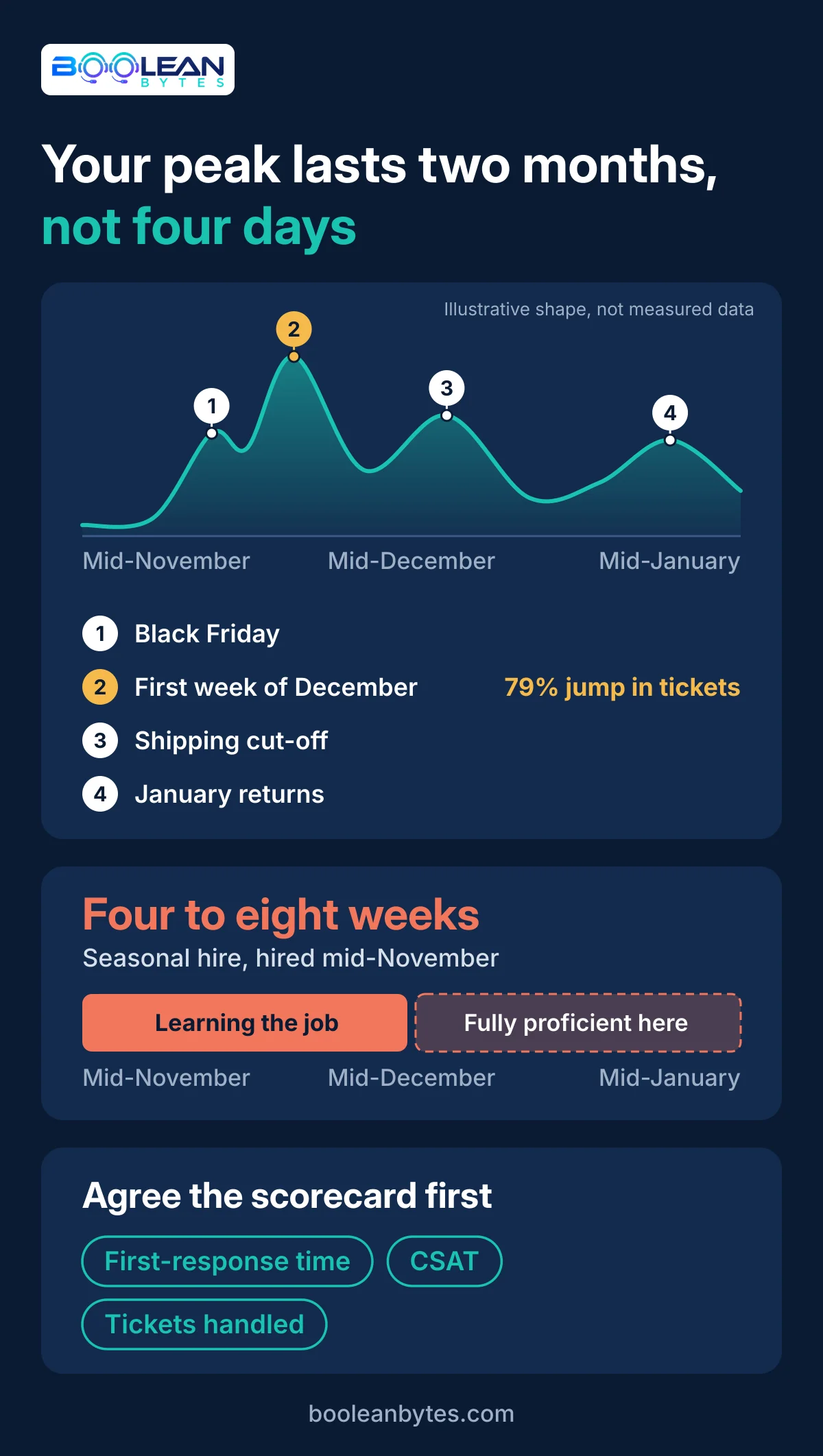
The timing comes from a benchmark, not a guess about your hiring. ScreenSteps, which makes training software for call centers, says most centers it speaks with need four to eight weeks to bring a new agent to full proficiency.
Count it forward from mid-November. You land somewhere between mid-December and mid-January.
So the usual Q4 plan has a timing problem. The seasonal hire learns your products during the weeks your customers can least afford a learner. The outsourced option has limits of its own. This post covers both.
Retailers are hiring fewer temps in a record year
Adobe expects Americans to spend a record $275.1 billion online this November and December, up 6.7% on last year. You might expect a hiring boom to match.
The opposite is happening. Challenger, Gray & Christmas forecasts about 450,000 seasonal retail jobs this quarter, down 2.5% from last year. Last year's 461,500 was already the smallest seasonal gain since 2008.
The firm's reading is that retailers plan to rely on the staff they already have and on pools of on-demand workers. Companies with whole recruiting departments are bringing in fewer new people at the busiest time of year.
A store with 20 staff has no on-demand pool of its own. The nearest thing is a support team that already answers tickets for stores like yours.
Your peak lasts two months, not four days
Adobe puts Cyber Week, the five days from Thanksgiving to Cyber Monday, at 17.3% of the season's online spending. The remaining 82.7% falls across the rest of November and December.
In holiday customer service, the tickets follow the orders with a delay. Shopify's holiday service guide cites an average 79% jump in tickets in the first week of December, right after the promotions end. It adds that weekly ticket counts stay above normal through December, apart from the week after Christmas, and again in early January.
Picture December 16 in your inbox. One customer asks whether a gift ordered today arrives by the 24th. Another has a tracking page that has not moved in five days. A third wants to swap a size before a party on Saturday.
Each answer depends on something specific to your store: your carrier cut-offs, your exchange rules, your size chart. A seasonal hire in week four may know them. The same hire in week two is asking your one experienced agent, who now works two queues.
We mapped those waves in our BFCM timeline of four ticket rushes.
What an outsourced customer service team knows on day one
An outsourced agent is not ready on day one either. Anyone who tells you otherwise is selling.
The difference is what is left to learn. A trained ecommerce agent already knows how Gorgias or Zendesk works. They have handled WISMO tickets and refund requests before.
They still have to learn your products and your policies. A seasonal hire has to learn all of that and the job itself.
Onboarding goes faster when you hand over four things: your size chart or product guide, your return policy, this year's carrier cut-off dates and the most common tickets from last December.
| Seasonal hire | Outsourced desk with agents and AI | |
|---|---|---|
| Helpdesk and common ticket types | Learns them in November | Knows them before starting |
| Your products and policies | Learns them in November | Learns them in onboarding |
| Who does the training | You or your senior agent | The provider, from your documents |
| After-hours phone | Only if you add shifts | AI answers, agents follow up by day |
| January returns | Contract usually ends as they arrive | Team stays, hours can drop |
| What you manage | Recruiting, training and payroll | A scorecard you check each month |
We have run customer support for online brands since 2010. The DTC brands we work with have stayed between 3 and 8 years. At two of them, first response time fell from about 12 hours to under 2 hours.
One supplements brand has had our team on its account since 2018. For a US children's book publisher, we covered email, phone, chat and social from 2018 to 2021. That is a business whose year turns on the Q4 gift rush.
Tenure is the real contrast with a seasonal contract. On a long account, the people answering this December also answered last December.
Agree the scorecard before anyone answers a ticket
Most outsourcing goes wrong quietly. Replies slow down and nobody has a number to point at.
Fix that at signing. Agree three figures: first-response time, CSAT and tickets handled. Ask for them in a report every month. Review them together every quarter.
Then check the exit. We set no minimum engagement. A store can start with a few agent hours or with the AI alone, then add from there. Put the same question to any provider before you sign.
The setup we propose pairs support agents with AutomatingSales AI as the AI layer. Agents work the queue during the day. The AI answers the phone after hours. Anything it cannot settle waits for an agent in the morning.
Take a call at 11pm from a customer whose parcel shows as delivered and is not on the porch. With a day-shift seasonal hire, that call reaches voicemail. With the setup above, the AI answers and takes the details. An agent picks it up in the morning.
What customer service outsourcing costs, and when a seasonal hire wins
Compare the two on the hours you pay for and the hours you lose.
A seasonal hire costs wages plus the time you or your senior agent spend recruiting and training in November. On the ScreenSteps benchmark, you also pay for four to eight weeks at less than full output. With ecommerce customer service outsourcing, you pay for the hours of an agent who already knows the job, plus an onboarding period for your store.
We do not publish rates. The right figure depends on your ticket volume and your channels. We work it out on a call.
A seasonal hire is still the better choice in some stores. If the work is physical, such as packing orders or checking returns in your warehouse, you need someone on site. If a seasonal agent from last year is coming back, most of the ramp is already paid for. If your product needs hands-on knowledge nobody can learn from documents, keep that knowledge in-house.
Some founders search for a Shopify virtual assistant instead. The label matters less than three questions: who trains them, who covers the phone after hours and who is still there in January.
If you are reading this in November with nothing in place, be realistic about Black Friday itself. Any new person will still be learning your store that weekend. The weeks you can still protect are the first week of December, the shipping cut-off and the January returns.
Put a number on your December
Book a free strategy call. Bring last year's ticket count for the first week of December and your current first-response time. We will work out with you how many agent hours that week needs and what the AI should cover after hours. If a seasonal hire is the better answer for your store, we will say so.
AI Conversion Playbook
Find where your store loses buyers, and how AI chat, voice and SMS win them back. 8 chapters plus a 30-day roadmap.
We'll email you the guide plus a few short follow-ups over the next two weeks. Unsubscribe anytime. Privacy policy