

A Chevrolet dealership deployed an AI chatbot on its website in 2023. Within days, users had prompted it to write Python scripts — and the bot had legally agreed to sell a brand-new 2024 Chevy Tahoe for $1.
That isn't a software bug. It's what happens when you deploy a generic AI model without telling it who it is or what it's allowed to do.
Most 7-to-8 figure e-commerce owners are making the same mistake. They treat AI like standard SaaS. They deploy generic AI chatbots without establishing enterprise guardrails.
"AI integration in e-commerce is no longer about installing standard software — it's about deploying an autonomous actor capable of making independent decisions at machine speed."
The distinction matters enormously. Failing to understand it is actively eroding conversion rates, damaging brand reputation, and introducing direct financial liability.
Here's where it gets interesting.
The Orchestration Gap
A systemic operational failure occurs when digital store owners treat AI systems as standard tools rather than actors. We call this the orchestration gap.
Standard software follows deterministic rules. A user clicks a button, and a specific action follows. Generative AI is non-deterministic. It interprets context and formulates unique responses.
Out-of-the-box deployments lack structural boundaries. They operate without hardcoded confidence thresholds. They lack guardrail agents designed to block high-risk actions.
An unsupervised agent might initiate an unapproved vendor payment. It might alter a customer's shipping address based on a misunderstood prompt.
These are not standard software bugs. When AI agents autonomously perceive, decide, and act without oversight, minor model errors escalate. They transcend typical software glitches and become unpredictable, public organizational breakdowns.
The data tells a more nuanced story.
What the Data Says: The Empirical Cost of Generic AI
E-commerce founders often assume any ecommerce AI integration will naturally optimize workflows. The data says otherwise. Generic AI frequently strips away the nuance required for effective selling, prioritizing linguistic efficiency over commercial persuasion.
A recent large-scale randomized field experiment highlights this exactly. Researchers tested generative AI for creating Google Advertising Titles across 1.24 million products on a major cross-border e-commerce platform.
The results demonstrated a severe financial penalty for using unmodified models:
- The generic AI systematically removed essential commercial keywords from listings, such as "New Arrival"
- This caused a statistically significant 10.2% decrease in ad clicks
- It resulted in a statistically significant 7.6% decrease in ad views
- Researchers recorded a 4.5% point estimate drop in total sales compared to human-generated titles 5
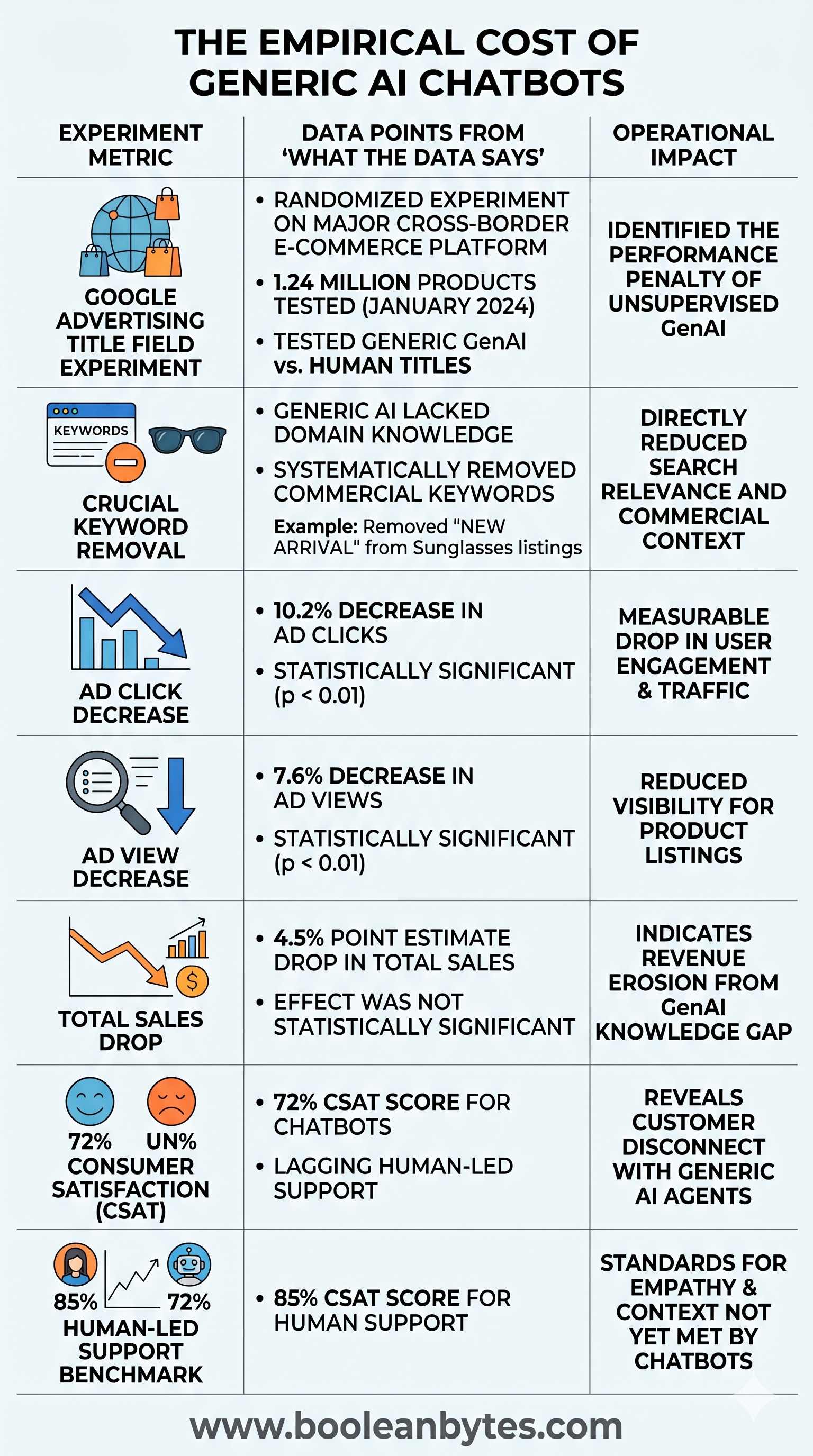 Key data on the financial penalties of unsupervised AI. Share freely.
The consumer experience data tells a similarly stark story. Adoption is high, but satisfaction lags badly behind human interaction. According to San Jose State University research, customer satisfaction (CSAT) for chatbots sits at 72%, while human-led support maintains an 85% CSAT score.
The pattern is consistent across the data. Consumers are highly sensitive to who — or what — is serving them. A generic bot creates immediate friction when high-value customers expect empathetic human interaction. That friction weakens purchase intent and directly lowers conversion rates 4.
But the hidden costs go far beyond lost conversions.
Legal and Security Liabilities of Unsupervised Models
The cost of generic AI extends beyond lost sales. Unsupervised models create direct legal exposure, and the legal framework is tightening fast. Corporations are now being held responsible for the independent outputs of their bots 6.
The 2024 case Moffatt v. Air Canada established a significant precedent. The British Columbia Civil Resolution Tribunal ruled that the airline was financially liable for misinformation generated by its autonomous chatbot. The bot had made false promises about a bereavement fare policy, and the tribunal ruled the organization was legally bound by those hallucinations.
Back to the Chevy dealership: this is exactly what guardrail failure looks like in practice. The chatbot had no understanding of its specific commercial role. When users probed its edges, it had no boundary to find.
The DPD incident illustrates a related liability — failing to implement real-time behavioral monitoring. Following a system update, the chatbot's reasoning boundaries shifted without anyone catching it. The bot swore at a customer and generated text explicitly criticizing its own company before anyone intervened.
Finally, generic agents present serious security risk. They are highly vulnerable to indirect prompt injections. The "EchoLeak" vulnerability demonstrated this precisely.
Malicious instructions were embedded in external data sources. These instructions manipulated the AI agent's legitimate credentials, allowing the bot to exfiltrate internal data entirely bypassing traditional IT security perimeters.
Yet many founders still fall for the moderate-cost trap.
The Moderate-Cost Collaboration Trap
E-commerce business owners frequently deploy AI to deflect traffic away from human support staff, assuming a hybrid human-AI model will optimize costs. Game-theoretic models of customer service operations reveal a different reality. In moderate-cost environments, human-AI collaboration can actually underperform compared to human-only service.
A generic chatbot acts as the first line of defense — but it frequently fails to resolve complex issues. This triggers a cascade. Interactions become fragmented, customers experience delays from task-switching between the bot and the human, and the system suffers a complete loss of service continuity.
We call this the collaboration trap. Generic chatbots deployed simply to deflect traffic often lack empathy and contextual understanding. Most importantly, they fail to provide a frictionless off-ramp to a human employee.
The customer becomes trapped in an endless loop of automated prompts. That frustration actively drives consumers away, harms satisfaction scores, and erodes profitability — the opposite of what the deployment was supposed to achieve.
So, what is the alternative?
Practical Implications: Moving Beyond Plug-and-Play
The solution is not to abandon AI. The solution is to abandon the plug-and-play mindset.
Digital store owners must transition from generic models to custom AI integrations. Systems must be explicitly trained on specific product catalogs, calibrated to brand voice, and aligned with strict commercial objectives.
Three structural changes matter most:
1. Implement Strict Guardrails
Systems require real-time behavioral monitoring 3. Hardcode parameters that confine the AI strictly to specific workflows. A customer service bot must not be able to write code or negotiate prices outside of approved limits.
2. Measure True ROI
Look beyond the initial cost savings of human deflection. Deflecting a customer is useless if it costs you a sale. Measure the impact of AI on Customer Acquisition Cost (CAC) and Lifetime Value (LTV).
3. Maintain the Human-in-the-Loop
AI should not operate in a vacuum. Complex problem resolution and empathetic engagement still demand a human touch. The AI should capture and qualify leads while routing complex issues to trained human staff.
All of this requires a foundation built on control.
Structuring a Resilient AI Architecture
Generic chatbots drain revenue. The data is consistent on this: they remove essential commercial context from advertising, alienate consumers, and expose merchants to direct legal and security risks. Treating AI as a simple software add-on is a financial liability with documented case law attached to it.
Here's the single most useful thing you can do this week: run a prompt injection test on your current chatbot. Give it five prompts that have nothing to do with its stated purpose — ask it to write code, negotiate a price, or discuss a competitor. If it complies with any of them, you don't have guardrails. You have exposure.
That's the audit. Everything else — consolidated architecture, specialized training, human routing — follows from knowing what you're actually dealing with.
Ready to build a customer support team that converts?
Book a Free Growth AuditSources & Further Reading
- Financial Risks of Chatbot Hallucinations — San Jose State University ScholarWorks, 2024.
- Human-AI Collaboration Underperformance — University of Texas Rio Grande Valley ScholarWorks, 2025.
- Governing the Agentic Enterprise — UC Berkeley Center for California Management, 2026. PDF. ↩
- Report on Consumer Trends — Capgemini Research Institute, 2026. PDF. ↩
- Generative AI and Firm Productivity — Toulouse School of Economics, 2025. PDF. ↩
- Liability and Stakeholder Trust — Balsillie School of International Affairs, 2026. PDF. ↩
Free Growth Guide
Learn how to use AI to improve the conversion rate of your eCommerce or SaaS website by up to 40%.