

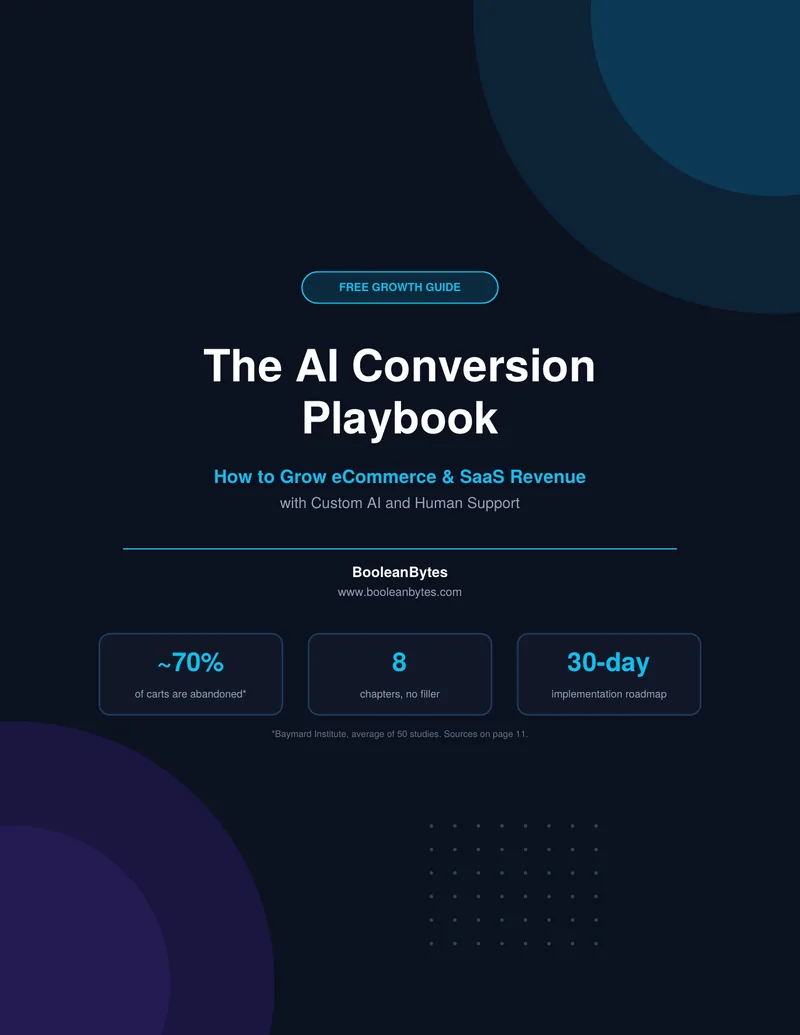
The AI Conversion Playbook
How Shopify brands use AI chat, AI voice and trained human support to answer buyers when they're ready to buy, without handing the hard conversations to a bot.
Free. Arrives in your inbox in a minute.
We'll email you the guide plus a few short follow-ups over the next two weeks. Unsubscribe anytime. Privacy policy
There's still time to set this up before Black Friday on Nov 27.
What's inside
- 1
The conversion gap: the three moments where store visitors leak, and the one that's easiest to measure
- 2
AI chat that actually converts: what a chat trained on your catalog does that a generic bot can't
- 3
AI voice agents: answering every call at 9 pm without a night shift
- 4
Abandoned cart recovery: a four-message sequence, and why the discount goes in message three
- 5
Personalized recommendations: where to place them and what to measure
- 6
Review management: turning reviews into proof at the point of decision
- 7
The human-in-the-loop formula: what AI handles, what people review, what people own
- 8
Your 30-day roadmap: audit, build, launch, optimize
Who it's for
- You run a Shopify brand with steady traffic and no dedicated support team.
- Pre-purchase questions about size, delivery dates and discount codes go unanswered after hours.
- You want AI that knows your store, with people handling refunds, upset customers and anything unusual.
Not for you if you want a plug-and-play bot to replace your team. Chapter 7 explains why that goes wrong.
Three things you can do this week (all from the guide)
List the 20 questions your customers ask most. That's the minimum your AI must know before it goes live.
Count the calls you missed after hours in the last 30 days. That number is the size of your after-hours gap.
Write down five situations where AI must hand off to a person. That list is your first guardrail.
Written by people who run support desks
BooleanBytes has run customer support for online brands since 2010. We have 26,245 hours logged on Upwork at 100% Job Success, and our clients stay 3 to 8 years. The guide comes from that work and from building AI chat and voice agents that sit alongside human teams.